In Japanese mythology the Sesho-seki stone is a volcanic rock that is purported to have kept a malevolent spirit imprisoned for almost 1000 years. The imprisoned demon was said to have been a beautiful woman who was part of a plot to kill Emperor Toba, ruler of Japan from 1107 to 1123

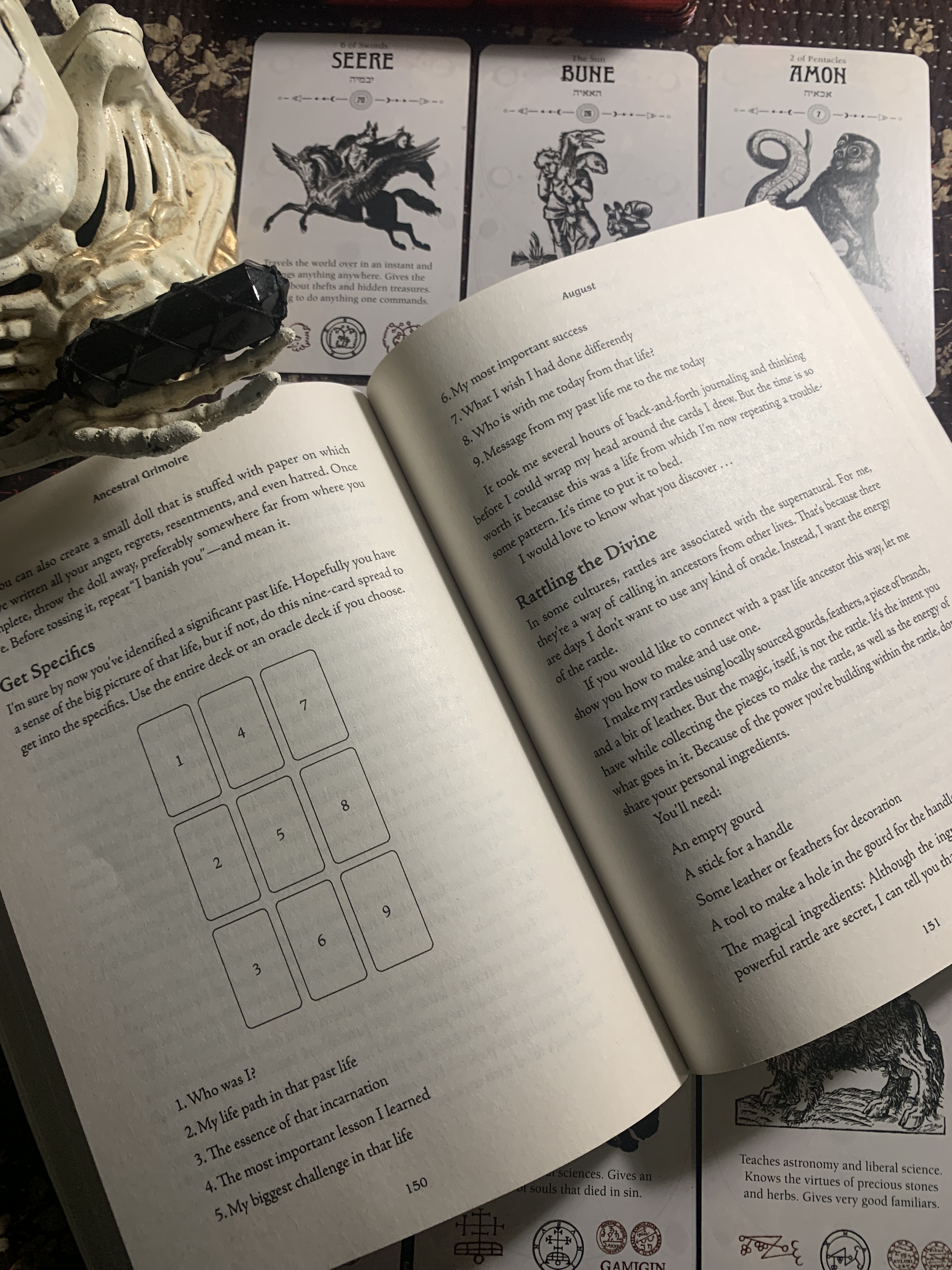
I have had plenty of cause to ponder and wonder what I did that could have resulted in me being imprisoned within a cast iron mould with a bit of a ‘Alas Poor Yorick‘ look. I have considered the fate of the beautiful woman who plotted to kill Emperor Toba and spent many hours, here within these confines, trying to recall what I did to anger those who determine how we are to live next.
As luck would have it a copy of Ancestor Grimoire by Nancy Hendrickson fell into the hands of my PR and most valued scribe. Using the pendulum you can see in my hand, she helped me glean that it is possible that I am enduring this fate because, despite being Alexander the Great’s closest confident, despite having done many very worthy things, there was, inevitably, a lot to answer for.
The truth is that the whole court, including myself, had blood on our hands. Inevitably there was vicious court politics with all the associated conspiracies, accusations of treachery, blackmails and executions. Court ‘parties’ battled for influence and when one group won, the losing courtiers would be damned and labelled as traitors and meted out severe punishments. And, given all the raiding, plundering and killing of innocent villagers, it is little wonder I have spent so many lives being ‘re-educated’ and redirecting my energy.
Don’t get me wrong! I have no real remorse. It was the culture of the time. Needless to say there is plenty to remember affectionately. It actually pleases me to pause and remember my life in ancient Macedonia.
The period from 320 to 250 BC was a time of great prosperity for Macedonia and throughout the 3rd and 2nd centuries BC, Pella was the centre of the Macedonian Kingdom, one of the most important states of that time. At this time Macedonia was a monarchy. While it was headed by the King there was a court full of royal pages, bodyguards, companions and friends who were close enough to the King to influence him. I was born into an aristocratic family whose main source of wealth and prestige was a substantial herd of horses and cattle. While the King had absolute power, my father was, quite literally, second only to the him in terms of power and privilege, helping to fill the ranks of his administration and serving as a commanding officer in the military.
Now, within the confines of this mould, as winter settles in, I gain comfort from meditating and recalling the carefree hours I spent at the Royal Palace, built in a strategic location defined by two rivers and the Pieria mountains. It was here that I was privileged to enjoy the companionship of the Kings son, Alexander. We basked in a 70 acre world in, what I now appreciate was a world of luxury, and became the dearest of lifelong friends.
Sometimes, when I close my eyes, I can remember running through the long corridors, zigzagging between the vast columns spying on the private dinner parties which were the favourite evening pastime among the men in our families. These forums enabled men to debate, plot, boast, or simply to revel with others. Guests reclined on couches while drinking wine and eating rich foods and were regularly entertained by professionals—mostly women and slaves—who danced, sang, and played musical instruments. Guests sometimes played games, told jokes and enjoyed lighthearted conversations on various issues. Needless to say, we were also privy to serious discussions on philosophical or literary topics, such as the nature of love, as well. I confess I particularly enjoyed competing in rounds of bawdy singing.
The most memorable banquet of them all was held to celebrate the marriage of King Phillip to a very young Macedonian noblewoman named Cleopatra. Despite polygamy being an accepted practice Alexander and his mother, Olympias, felt slighted and heated sparks flew and bubbled over when Cleopatra’s uncle called upon everyone to pray that this union might bring forth a legitimate heir.
I will never forget what transpired! Alexander flew into a rage at these words, shouted at him, ‘Villain, do you take me for a bastard, then?’ and hurled a drinking-cup at his head. At this Philip lurched to his feet, and drew his sword against his son, but fortunately for them both he was so overcome with drink and with rage that he tripped and fell headlong. Things were very tense for awhile and Alexander and his mother made a hasty retreat, seeking refuge until things calmed.
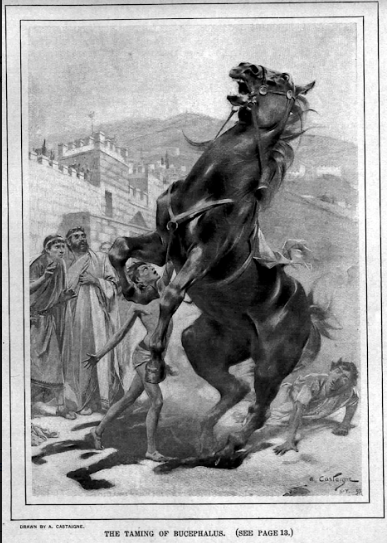
Perhaps my fondest memory of growing up in the company of Alexander was of the idyllic hours we spent in the palaestra exercising and swimming in a large swimming pool. I was with Alexander when he tamed a wild horse named Bucephalus. We prized horses and Bucephalus was an impressive animal with impeccable breeding. He hailed from the “best Thessalian strain” of horses. When he arrived he was a wild spirited, unmanageable, massive, black coated creature with a large white star on his massive forehead. Because he was both vicious and unmanageable and would not allow anyone to mount him King Phillip wasn’t interested in him. It was Alexander who, still only a boy of thirteen, took up the challenge and won the heart of the fiery stallion. Bucephalus, perhaps one of the most famous horses in history, faithfully served him in many battles until his death at the Battle of the Hydaspes.
Like other boys born into aristocratic families we were tutored from a young age. As contemporaries we were educated under Aristotle at Mieza in the Temple of Nymphs, a kind of boarding school. We learned mathematics, reading, writing and enjoyed reading the works of Homer, the Iliad and the Odyssey. Our education was comprehensive and we studied philosophy, religion, logic, morals, medicine, and art. At school we met and studied with many of Alexander’s future generals and friends, such as Ptolemy and Cassander.

Royal hunting was another important royal activity. It was exciting to be able to would go hunting with the King. Like the symposia, royal hunts served the purpose of bonding the King with his companion and provided some respite from campaigns. They served as a venue for interaction between the nobles and the monarch. It also served as a rather egalitarian exercise where everyone had the chance to prove his worth and it was a chance for the King to show his individual virtues and display his skills.
It was inevitable that we would all become members of the King Phillip 11’s army. Prior to his reforms, the kingdom had produced some decent cavalry, but included few other soldiers of much account. Phillip completely reformed the army and it rightly came to be regarded as the greatest military force of the ancient world.
As teens we young men were sent to fight in King Phillip II’s campaigns against the Thracians in 342 BC. I had previously been engaged in the battle of Chaeronea in 338 BC. We became an elite, formidable group. We were regarded as the best of the best. As friends of the King we were appointed for life and came to be known as Companions. We felt honoured to hold the right flank of Macedonian armies alongside the King, who, unlike politicians today, set such an example of personal courage. He conspicuously shared the rigours of marching and riding thousands of miles with his men, enduring fatigue, hunger, thirst and the extremes of climate. In battle he led from the front, fighting hand-to-hand and suffered a long catalogue of wounds. Heavily armoured and armed with a double tipped 3-4 meter long spear, called a xyston we literally acted as the mounted Royal Bodyguard.
Eventually Alexander inherited this fierce fighting force, an army of the kind never seen before. Like his father he was always at the forefront with his men, but perhaps, most importantly, much of his outstanding success can be attributed to the fact that he was a shrewd tactician and strategic thinker, a true leader who not only knew how to draw the best out of the men who were prepared to die with him, but dealt swiftly with any whiff of subordination or mutinous behaviour. As history makes very clear, Alexander was a unique force, a superhuman who believed divine blood ran through his veins.
Some commentators have dismissed me as an obsequious sycophant! There is no denying that I was not the ultimate military man! Alexander deliberately kept me away from a lot of battles. My value lay elsewhere. He believed me to be a gifted diplomat and logistical thinker, valued my advice and made me Commander of his body guards. What you have to understand is that it is true that no man is an island and behind every successful person stands others. Alexander not only had an army but he also had and extensive entourage of talented non combative supporters who may have never seen battle but who were essential for Alexander and Companions like me to maintain the ‘war machine’.
 Wild Mother Calling