Having named my project and, given that I think this particular project has ‘legs’, I have established a new site and I will gradually be migrating material on to it.
Make sure to visit at Waltz With A Matilda to learn more about Australian Women and how Tarot and their stories intersect.
In its most positive state, the Four of Pentacles suggests that you have created wealth and abundance by maintaining a steady focus on your goals and acting conservatively. You are attentive to your long-term financial security, actively saving money and watching your expenses so you can accumulate wealth and live a comfortable lifestyle not just now but also in the future. Biddy Tarot
This rendition of the Four of Pentacles invokes the King Midas myth. Marigold, was the daughter of Midas, the king who was given the power to turn anything into gold with his touch. Unfortunately, she too was also turned to gold. Because of this, Midas despised his accursed power and sought help from the God of Wine, Dionysus.
This sobering myth has done nothing to quench the desire of many to accumulate massive wealth. Gina Rinehart, the daughter of iron-ore explorer Lang Hancock, rebuilt he father’s financially distressed company. She holds the title of being the richest woman in Australia. Her biggest asset is the Roy Hill Mining project which started shipments to Asia in 2015.
This card can be confronting when it is perceived to speak of stinginess, emotional selfishness, possessiveness, avarice, control freak behaviours, staking claims and blatant materialism. We all know that wealth accumulators can become trapped by their fear of loss or need to keep accumulating.
This female mining magnate is also Australia’s second largest cattle producer, with a portfolio of properties across the country.
If it is true that Rinehart deliberately deflated the value of mining shares in a family trust, to the detriment of her own children’s inheritance, her children are unlikely to turn into gold.
Rinehart has been honoured for her contribution to business, as well as her philanthropy, which ranges from providing support for breast cancer research, being a champion for Veterans, to sponsorship of Australian Olympians. However she doesn’t top the list of philanthropists and it is questionable how any one person can justify their stash of billions .
There is nothing wrong. with the pursuit of wealth but it is important to remember that we never truly own things in life. As the stripped Egyptian Tombs reveal, the treasures we cling to today will eventually belong to someone else.
Perhaps one of the most in your face depictions of the Four of Pentacles is in the Deviant Moon Tarot by Patrick Valenza. His card illustrates the ugly consequences of putting material gain above all else. A grotesque demon escorts a wicked miser from his counting house and leads him to the roaring flames of damnation. Like this miser the fear and greed of those amassing such fortunes may well lead towards a future filled with the kind of regret experienced by King Midas.
The symbolism in the Five of Wands suggests that there is form of conflict in one’s life. This may be an existing conflict or one that is brewing and may eventually blow up in one’s face. It may also depict a problem in communication, for example in a situation where no one really wants to listen to the other – meaning that no agreement or understanding takes place.
Cotton was born in Sydney in 1911, daughter of Florence (pianist/painter) and Leo (geologist) both whom shared interest in photography. During early childhood, Cotton was privy to aspects of environment and developed a love of the world around her. At age 11, Cotton was given her first camera and her love of photography grew from this.
In 1934, Olive Cotton graduated from the university of Sydney and began working in the studio of Australian photographer Max Dupain, a childhood friend who she married. Cotton and Dupain had been childhood friends who grew up sharing a keen interest in the evolving medium of photography. Cotton and Dupain became romantically involved in 1928 and married in 1939. However marrying each other exposed them to some uncomfortable truths and they separated in 1941, eventually divorcing in 1944.
The Five of Wands shows us a battle of egos, people fighting to find out who is strongest. It may be presumptuous to suggest that a battle over egos was what divided this photographic couple, for in reality there were contributing factors outside their control. For example, in line with social convention, women were banned from working in the public service and other occupations in Australia after they married, so as soon as they married Cotton’s status changed.
On top of this was the accepted standard division of labour in which the husband was expected to be the breadwinner and the wife the homemaker and child-bearer. This meant Olive was no longer able to be fully immersed in the social and creative flux of studio life and was removed from the camaraderie and satisfaction that her work as the assistant had previously engendered.
Clearly there were other factors but the collective result was that their marriage did not last long. However, despite this, they did share a long and close personal and professional relationship. An exhibition looks of their work made between 1934 and 1945, the period of their professional association, reveals an exciting period of experimentation and growth in Australian photography. Cotton and Dupain were at the centre of these developments.
Van Diemen’s Land was the colonial name of the island of Tasmania used by the British during the European exploration of Australia in the 19th century. A British settlement was established in Van Diemen’s Land in 1803 before it became a separate colony in 1825. Its penal colonies became notorious destinations for the transportation of convicts due to the harsh environment, isolation and reputation for being inescapable. Macquarie Harbour and Port Arthur are among the most well-known penal settlements on the island.
“Sometimes you don’t realize your own strength until you come face to face with your greatest weakness.” – Susan Gale
Strength Card Light Seers Tarot
Between 1788 and 1868 more than 162,000 convicts were transported to Australia. Transportation as a form of criminal punishment emerged in the British legal system from the early 17th century as an alternative to execution.
Many of the crimes for which they were transported are considered minor offenses by today’s standards. The most common crime by far was stealing—food, clothing, money, household items—mostly items worth no more than £5.
One can only imagine how my great great grandmother, Mary Ann Maule, had been living prior to her sentencing after a series of petty thefts. Clearly Mary was no angel but conditions in Liverpool were particularly harsh. Houses were severely overcrowded and the impact of the Great Famine, known as the Irish Famine was profound.
Friedrich Engels was shocked when he visited Liverpool in the 1840s. “Liverpool, with all its commerce, wealth, and grandeur yet treats its workers with the same barbarity. A full fifth of the population, more than 45,000 human beings, live in narrow, dark, damp, badly ventilated cellar dwellings, of which there are 7,862 in the city.
“Strength does not come from winning. Your struggles develop your strengths. When you go through hardships and decide not to surrender, that is strength.”– Arnold Schwarzenegger
Having survived the long, perilous journey on board the convict ship, there can be no doubt that life would have been no easier when she arrived in the colony. However, the scarcity of women opened up opportunities for convict women as servants and wives. Many, including Mary Ann, successfully merged into colonial society, creating new families, and through good conduct and hard work forged new lives. Convict women, like my great great grandmother, demonstrated a diversity of character, aspirations and behaviour, which contradicted their stereotype as ‘damned whores’.
Her legacy of strength and fortitude has been far reaching.
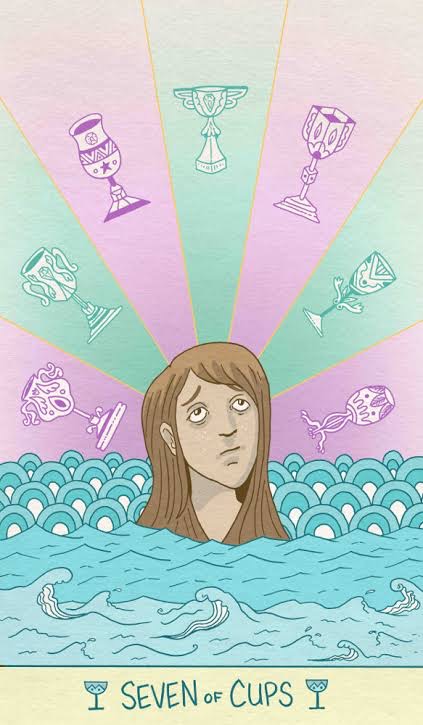
Passion is the fuel that powers the engine of our desires and our ambitions. The challenge for most of us is to learn to channel our ambitions wisely, or they can ignite and blow things up. One of the dilemmas when are confronted with the Seven of Cups is that we can feel like we are drowning, feel utterly overwhelmed.
Kabbalists are said to call the Seven of Cups tarot the Lord of Illusory Success! Unfortunately it can all be like that mirage you see in the desert! Like the Wizard of Oz it can all be an illusion, all done with smoke and mirrors.
Happily the Seven of Cups does allows us to explore our wildest, most exotic fantasies without having to worry about the real world consequences. Writing our discoveries into your journal or expressing them artistically will be very instructive.
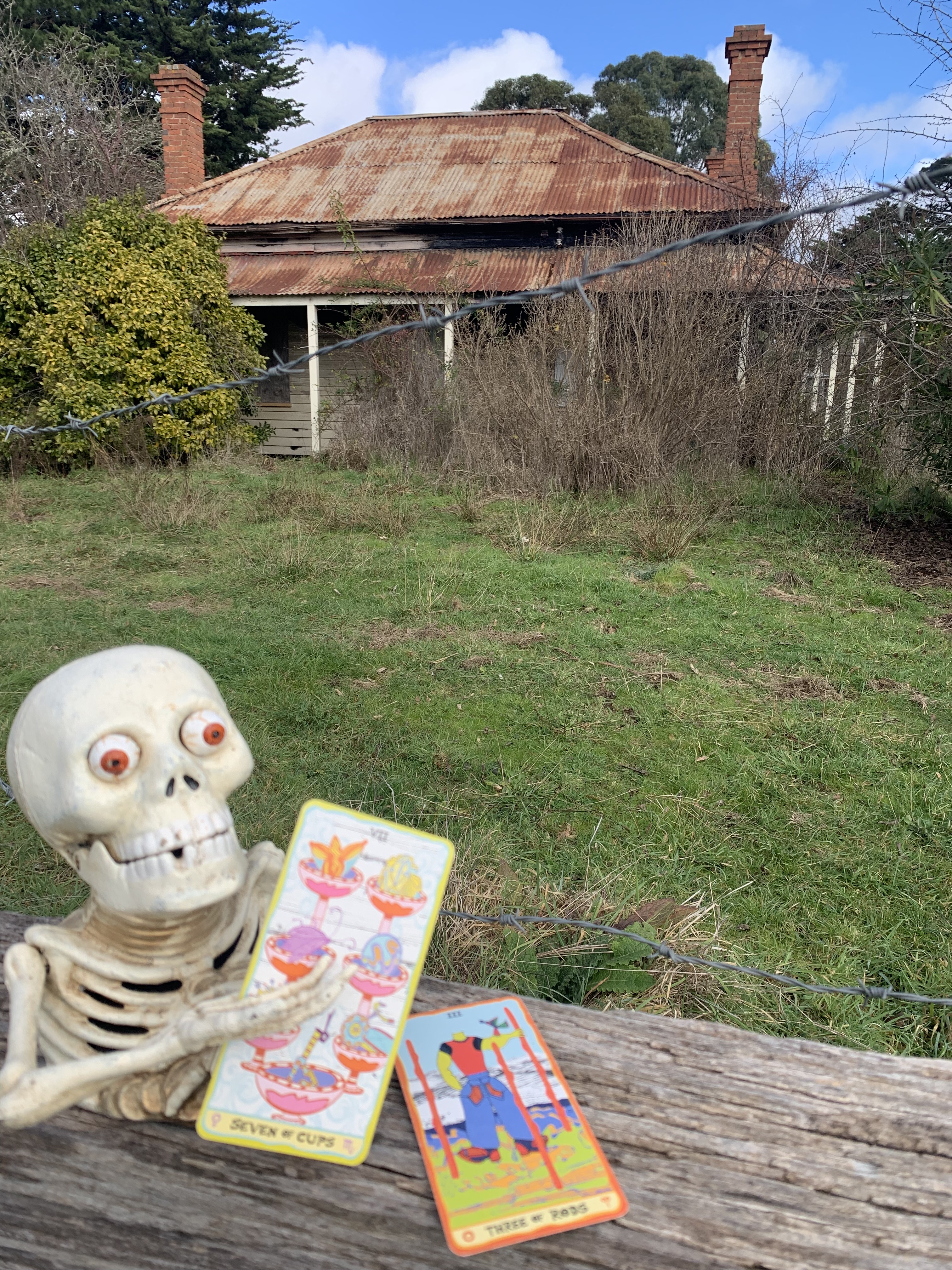
Alternatively, if we are lucky enough to have one, we can send out an SOS and seek advice from a Zen Master. As luck has it, Skellie Stan bridges the gap for me and is willing to act as a conduit and pass on advice from the dead and abandoned. It was his idea to go to a grave of a creative man that we have often noticed in a nearby cemetery, and to stop at one of the farm houses that has long been abandoned. He seemed to think that they would be responsive.
Jack, who resides in this amazingly kept grave was quite emphatic, telling Stan to tell me that I must select cups that support the creative work I am doing, while the old house suggested that I chill it a bit, relax and enjoy life. The advice feels compatible.
CarlJung separates parts of our personality out into ‘that which we are conscious of’ and elements ‘that which we are unconscious of’. Our conscious mind is where the ‘ego’ sits and is made up of the parts of our personality and identity that we are aware of.
The trouble with personas, according to Jung, is that it can lead to aspects of one’s personality (both good and bad) being unexplored, underdeveloped, and suppressed. Through a desire to please others, we focus on our qualities which we perceive to be acceptable by others and hide the parts of ourselves which we believe to be negative.
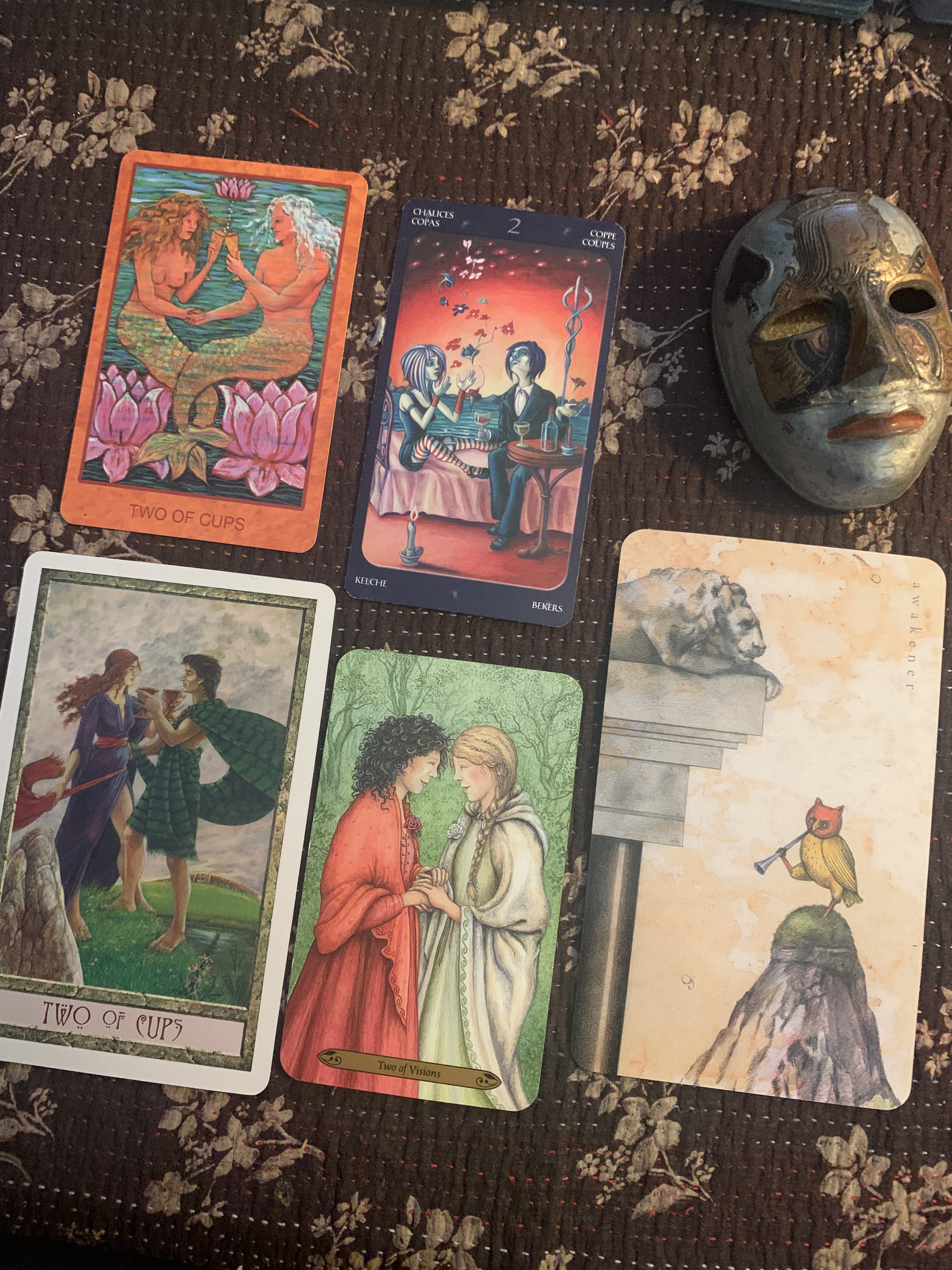
The Two of Cups generally shows a young man and woman, exchanging cups and pledging their love for one another but the symbolism of this card encompasses so much more than just romantic love. What we see here might also indicate the beginning of a lifelong friendship, a “meeting of the minds” – or any situation in which human energies enrich and transform one another.
Another approach is to take the opportunity to court, to romance a part of yourself that has been underdeveloped. To identify such an aspect you might lay out Two of Cups cards from a number of deck (see above). Then place a card from the Archeo, Personal Archetype Cards by Nick Bantock or from the Carolyn Myss Archetype Cards. Spend some time in your journal exploring the benefits of connecting more fully with this archetype.
Decisions Decisions!
Flip through an archetype deck and decide which archetypes need a bit of love, need to be courted and activated. Lay down the cards and perhaps make use of a Show Me style deck to pose a question to begin some work with these archetypes. See example below. Dialogue with the archetype and work out how you can use the energy of, in this case, the Ace of Rods.
To the extent you’re aware of the archetypes operating within you is an indicator of your level of consciousness.
“The Tower has a simple meaning: The crumbling of the status quo. This card’s usual image of lightening destroying a tower is incredibly scary – destruction is all that we can see. The ground is unsteady beneath our feet. We don’t know what to hold on to”. Little Red Tarot
Having your home destroyed by fire or flood, quitting your job, getting fired, finding yourself living rough, being ghosted by someone you love, losing a friend, having a loved one die are all examples of Tower moments. Lets state the obvious. The shock from events like this feels incredibly painful and sadly, there are rarely any quick fixes. But, eventually, despite our despair, most of us pick ourselves up and slowly rebuild.
Without sounding glib, or suggesting that doing a Tarot spread will fix things, it must be said that working with cards may help adjust one’s perspective and help someone find a way forward. Assuming you have come up for air this is an example of a spread with cards that might help you find some clarity. The Show Me cards are great because, at a time when you are not sure what you want to know, they help you ask whoever is listening, to just shed some light on possible options.
Rather than provide a ‘reading’ of the cards that appeared from the Forest of Enchantment Tarot, I’ll let you consider which responses are in any way helpful.
“The Six of Cups can often be about connecting backwards, with family, grandparents, or perhaps ancestors. Think about the place from which you came, and your relationship to it now. In what ways to you carry forwards your own root?” Little Red Tarot
The Six of Cups represents innocence, nostalgia, and positive thinking. The card has an overall feel of childhood and nostalgia.
It is no accident that in movies like Titanic we see the dying Rose being reunited with all the people who were on board that fated ship. This is very Six of Cups nostalgia that reduced most of the audience to tears
Faced with death on the battle field of the Great War its not hard to believe that Bubs Corbetts thoughts would have turned to the country, family and the lifestyle he had left behind.
In the face of so much death and horror one can only hope that Bubs gained some comfort remembering the love and the bonds of relationships that he left behind.
It would be reassuring to think that, like Rose or Maximus Decimus Meridius (The Gladiator), he found his way back ‘home’ to walk in the door and be greeted by his loved ones.






 Wild Mother Calling