Having named my project and, given that I think this particular project has ‘legs’, I have established a new site and I will gradually be migrating material on to it.
Make sure to visit at Waltz With A Matilda to learn more about Australian Women and how Tarot and their stories intersect.
The Four of Wands indicates that plans have begun to bear fruit and that desires are being attained. The appearance of this card suggests that all the hard work is not only being rewarded but that the creative project one has embarked on has the potential to develop even further. More hard work and commitment may be demanded but it will be worth it.
Everything about the contribution Cheryl Salisbury made to women’s football and the Matilda’s Football team oozes with Four of Wands energy. A pioneer of women’s football, Salisbury became Australia’s most-capped player of either gender and has been credited with being a driving force behind the Matildas becoming a true contender in the world game.
Matildas all-time cap leader Cheryl Salisbury has been named alongside a plethora of Australian male footballers into the Australian Sports Hall of Fame.
Salisbury joined the likes of John Warren, Harry Kewell and Ray Baartz in admittance to Australian sport’s premier pantheon, becoming the first Matilda to do so.
Salisbury captained the Matildas for seven years from 2003 until she retired in 2009, having played in four World Cups in 1995, 1999, 2003 and 2007 as well as the Sydney 2000 and Athens 2004 Olympic Games, and the 2006 and 2008 Football Confederation Women’s Asian Cups. At the Sydney Olympics she scored Australia’s first ever goal at that level and at the 2007 World Cup she scored the goal -with effectively the last kick of the game -that secured Australia’s passage to the quarterfinals for the first time.
Salisbury’s dedication was fully recognised when she inducted into the Sport Australia Hall of Fame in 2019 as an Athlete Member for her contribution to the sport of football.
The Four of Swords can signal that it is time to retreat. The Four of Swords is a moment of rest. Whether this is from a choice to withdraw, or whether it is from pure exhaustion, it is not clear.
Leigh Sales joined the ABC in Brisbane in 1995 as a junior reporter and went on to hold a series of senior roles, including being NSW State Political Reporter and National Security Correspondent. From 2001-2005 she was the ABC’s Washington correspondent, covering stories including the Iraq War, the 2004 US Presidential election, Guantanamo Bay and Hurricane Katrina. She returned to Australia as anchor of Lateline for three years before taking over at 7.30.
In her time in the role as anchor Sales interviewed hundreds of leaders, newsmakers, celebrities and other people of note, at home and abroad – including tonight’s Australian TV exclusive interview with US Secretary of State Antony Blinken.
Knowing when to let go!
It is not always easy tobe in touch with your purpose in life. Knowing when to let go and ‘leave the building’ takes courage. Usually the move is associated with a desire to find a peaceful, still place. It is a time to shift the focus inwardly so that recovery and healing can take place.
“It is in periods of rest that some of the best ideas are born, when the mind is left to its own imaginative devices and has the space to process in its own way.
This card is imbued with a spiritual tranquility and stillness. Sometimes showing a person resting inside a church interior, it points to the kind of rest we can get when our souls are at peace. We tune out from the bustle and in to a more spiritual, inner peace. The Four of Swords can lead us to a deeper spiritual practice, allowing us to overcome a chattering, worrying ego and feel peaceful and connected”. from Little Red Tarot
In her announcement Sales made reference to spending more time with her two young sons. The Four of Swords is all about making decisions like this, it is about redirecting our priorities.
The Seven of Wands is an activist’s card. It’s that image that shows up to say ‘your truth belongs to you. Hold it high.’ For some of us this may be an actual fight for survival in a society that won’t accept our existence. For others, it is about standing tall and getting our message out there so it can be heard – again, this can feel like a fight. Little Red Tarot
“Dr Lowitja O’Donoghue has dedicated a lifetime to upholding Aboriginal and Torres Strait Islander rights to improve outcomes in health, education, political representation, land rights and reconciliation”
Lowitja O’Donoghue was born in 1932 at Indulkana, in the remote north-west corner of South Australia, to a Pitjantjatjara mother and an Irish father. When she was just two years old, she and two of her sisters were taken away from their mother by missionaries on behalf of South Australia’s Aboriginal Protection Board.
Renamed ‘Lois’ by the missionaries, she and her sisters grew up at Colebrook Children’s Home and did not see their mother again for more than thirty years. They weren’t allowed to speak their own language or to ask questions about their origins or even about their parents. Aboriginal girls brought up in the missions were trained in domestic service with the expectation that at age 16 they would seek employment as domestics.
O’Donoghue’s work on behalf of Aboriginal rights began in the early 1950s when she tried to extend her qualifications after working as a nursing aide at the local hospital.. She applied to complete her training at the Royal Adelaide Hospital, but was refused the opportunity because she was Aboriginal. She fought the decision, which was eventually overturned and she became the first Aboriginal person to train as a nurse at the hospital. She had by then joined the Aboriginal Advancement League, to advocate on behalf of other Aborigines and specifically to ensure employment options other than domestic work for women and manual labour for men could be available to them.
“Lowitja O’Donoghue is one of those Australians who is universally admired,” said Ms Burney in a statement.
“She broke down so many barriers, faced up to racism, overcame adversity and demonstrated that First Nations peoples can achieve anything they put their mind to.”
Lowitja O’Donoghue’s leadership in Aboriginal rights has been highly influential. A member of the stolen generation, she has also been an advocate of reconciliation and avoided politics of confrontation, finding conciliation to be more effective.
Dr O’Donoghue has received numerous awards and accolades for her work. She was made a Commander of the Order of the British Empire (CBE) in 1983 and Australian of the Year in 1984, during which time she became the first Aboriginal person to address the United Nations General Assembly. She won the Advance Australia Award in 1982, was named a National Living Treasure in 1998, and awarded Companion of the Order of Australia (AC) in 1999 and Dame of the Order of St Gregory the Great (DSG), a Papal Award, in 2005.
The Seven of Swords tarot card stands for trickery, theft, and dishonesty. You or someone around you might be using deceitful tactics to achieve a goal.The intention of these actions is deliberate and they are done without thought of how it will affect other people.
Born Elizabeth Jessie Huntin 1890, in NSW, Jessie’s mother sold her to a travelling circus when she was just eight.
By the age of 17, Jessie was a champion rough rider and ring mistress of Martini’s Buck Jumping Show.
Leaving the circus, in 1913 a pregnant Jessie waved Ben Hickman off to war. Shortly afterwards Jessie gave their son to a friend to raise and headed to Sydney for a life of crime.
Jessie stole cattle, pinched clothing and dodged the police.
Unfortunately for her, she wasn’t always fast enough.
By 1916 she had served two terms in Long Bay Goal and was charged again in 1918.
The Six of Wands is all about public recognition, victory, and success. Not only have you managed to properly succeed in achieving all of your goals, but you are also being publicly acknowledged for them and the results that you’ve managed to attain. You may have received an award or some sort of public acclaim.
Born in 1886 in Potts Point, Sydney, Kellerman had rickets and needed leg braces as a child. When doctors prescribed swimming as a strengthening treatment she surpassed all their expectations and became a champion. But this was only the beginning of her dazzlingly diverse career.
Annette Kellerman’s achievements are extraordinary: champion swimmer and diver, vaudeville performer, international silent film star, stunt performer and entrepreneur.
The Six of Wands offers us a picture of victory. Something has worked out well, and this is a time to feel proud. There are plenty of parallels with the Four of Wands here, though whilst that card was about the energy of celebration itself, the Six is focused on the experience of triumph. Little Red Tarot
The moment of triumph we see in the Six of Wands can take many forms. In the Wild Unknown Tarot, the card shows a butterfly, rising up from a sea of shadows. This is about spreading our wings and feeling free. It’s a moment of becoming, of personal celebration.
In the Mythic Tarot by Juliette Sharman Burke we see Jason triumphantly holding up the Golden Fleece. It is a time to be recognised by others and receive acclaim. His crew are there, honouring him by holding up Wands. It is a heady moment after having striven for so long but there are more battles to be fought. Consider moments when you have received acknowledgement of some kind. This might be a promotion, gaining a qualification or recognition for creative work.
The Hanged Man card is sometimes referred to as the traitor card. As history makes blatantly clear, persons whose individual conscience is in opposition or divergent from the collective viewpoint, can appear as traitors to the Establishment. Often upside down in relation to family, friends and the government, nonconformists can be even branded as criminals.
“Clift’s is one of the voices – and one of the most important female voices – that rose above the crowd during the post-war period, as the western world unknowingly girded itself for the social revolution that was to come.
Through her columns she advocated for a bolder, more outward looking future, and as someone who was naturally cosmopolitan she was avidly interested in seeing Australia become more open to the world and better integrated into the Asia-Pacific”.
When Prometheus willingly defied Zeus and gave shivering man a firestick he was severely punished. There is plenty of evidence that humankind is as unforgiving as Zeus. It does not respond well to those who defy establishment. But without these sacred rebels we would not have advanced beyond the cave days.
It is unlikely that Prometheus, who is shown here being punished for his defiance, was on Charmian Clift’ mind when she challenged society, but her acts were no less Herculean. Like Prometheus she confronted the fall out from stepping outside the lines of society.
Clift was born on 30 August 1923 in the last of a straggle of weatherboard workers’ cottages on the outskirts of the New South Wales coastal township of Kiama. Both socially and geographically, the little settlement of North Kiama was regarded by the townsfolk as being on the wrong side of the tracks. Of course we all know that growing up in ‘the sticks’ is not always a deterrent. Many shining stars, whose legacy lives long after them, have risen, perhaps to spite their humble beginnings.
The Hanged Man represents independence from the flock, the willingness to see things differently, see them your way. It can point to critical thinking or awareness (especially when paired with other cards that deal with this theme) and it can represent courage. Little Red Tarot
Charmian Clift was in the vanguard of the post-World War II wave of feminism, attracting large and loyal audiences for her columns in the Sydney Morning Herald and Melbourne Herald. Commissioned to write columns “from a woman’s point of view”, Clift wrote powerfully, passionately and emotionally in essay style about the Vietnam War, conscription, world hunger and the Greek junta. Many prominent women writers, including Helen Garner and Elizabeth Riddell, have referred to Clift’s work as an inspiration. Clift survived the scandal of an affair with her long-time famous partner George Johnston and the social restrictions on women in the 1940s to become a significant figure as a journalist and author in her own right.
In its most positive state, the Four of Pentacles suggests that you have created wealth and abundance by maintaining a steady focus on your goals and acting conservatively. You are attentive to your long-term financial security, actively saving money and watching your expenses so you can accumulate wealth and live a comfortable lifestyle not just now but also in the future. Biddy Tarot
This rendition of the Four of Pentacles invokes the King Midas myth. Marigold, was the daughter of Midas, the king who was given the power to turn anything into gold with his touch. Unfortunately, she too was also turned to gold. Because of this, Midas despised his accursed power and sought help from the God of Wine, Dionysus.
This sobering myth has done nothing to quench the desire of many to accumulate massive wealth. Gina Rinehart, the daughter of iron-ore explorer Lang Hancock, rebuilt he father’s financially distressed company. She holds the title of being the richest woman in Australia. Her biggest asset is the Roy Hill Mining project which started shipments to Asia in 2015.
This card can be confronting when it is perceived to speak of stinginess, emotional selfishness, possessiveness, avarice, control freak behaviours, staking claims and blatant materialism. We all know that wealth accumulators can become trapped by their fear of loss or need to keep accumulating.
This female mining magnate is also Australia’s second largest cattle producer, with a portfolio of properties across the country.
If it is true that Rinehart deliberately deflated the value of mining shares in a family trust, to the detriment of her own children’s inheritance, her children are unlikely to turn into gold.
Rinehart has been honoured for her contribution to business, as well as her philanthropy, which ranges from providing support for breast cancer research, being a champion for Veterans, to sponsorship of Australian Olympians. However she doesn’t top the list of philanthropists and it is questionable how any one person can justify their stash of billions .
There is nothing wrong. with the pursuit of wealth but it is important to remember that we never truly own things in life. As the stripped Egyptian Tombs reveal, the treasures we cling to today will eventually belong to someone else.
Perhaps one of the most in your face depictions of the Four of Pentacles is in the Deviant Moon Tarot by Patrick Valenza. His card illustrates the ugly consequences of putting material gain above all else. A grotesque demon escorts a wicked miser from his counting house and leads him to the roaring flames of damnation. Like this miser the fear and greed of those amassing such fortunes may well lead towards a future filled with the kind of regret experienced by King Midas.
The Magician shows us that you are able to master any desired skill through practice, sacrifice and a determined focus on your outcome. He encourages you to invest the time to cultivate your potential abilities. Patrick Valenza – Deviant Moon Tarot.
When she was just a five year old kid, Cath Jamison got a magic kit, loved it and started putting on magic shows for her family. She used to try to make the dog disappear and she confesses that she had a crack at making a pier vanish as well. But she is not about to divulge any of her secrets. This award winning Australian entertainer has no hesitation in saying that she was a quirky kid and that she still is a quirky person.
Pulling the Magician in a reading is a reminder that you have the necessary tools to manifest your dreams. Just as the man depicted in the Magician card has learned to wield the unseen forces of the universe, so, too, can we learn to master our own skills to get the outcomes we desire.
Today Cath’s mind-blowing and frequently uproarious shows have earned her a reputation as a leader in her field and she’s known as one of Australia’s most unusual women entertainers, wielding her trademark sass and mind illusion. Jamison is an impressive entertainer who delivers a masterful blend of magic, mentalism, and enjoyable audience engagement.
As a part of my project to identify Australian women who help to explain the energetic of a Tarot Card I am endeavoring to put together interpretive drawings which help to tell stories about the women. For example, anthropologist, Marcia Langton is surrounded by Indigenous artifacts which can be found online, while the tragic legacy of the early missionaries who worked in Indigenous missions surrounds Annie Lock.
Joan Lindsay Picnic at Hanging RockLighthouse Keepers DaughterAnnie Lock MissionaryMarcia Langton Indigenous Anthropologist
The symbolism in the Five of Wands suggests that there is form of conflict in one’s life. This may be an existing conflict or one that is brewing and may eventually blow up in one’s face. It may also depict a problem in communication, for example in a situation where no one really wants to listen to the other – meaning that no agreement or understanding takes place.
Cotton was born in Sydney in 1911, daughter of Florence (pianist/painter) and Leo (geologist) both whom shared interest in photography. During early childhood, Cotton was privy to aspects of environment and developed a love of the world around her. At age 11, Cotton was given her first camera and her love of photography grew from this.
In 1934, Olive Cotton graduated from the university of Sydney and began working in the studio of Australian photographer Max Dupain, a childhood friend who she married. Cotton and Dupain had been childhood friends who grew up sharing a keen interest in the evolving medium of photography. Cotton and Dupain became romantically involved in 1928 and married in 1939. However marrying each other exposed them to some uncomfortable truths and they separated in 1941, eventually divorcing in 1944.
The Five of Wands shows us a battle of egos, people fighting to find out who is strongest. It may be presumptuous to suggest that a battle over egos was what divided this photographic couple, for in reality there were contributing factors outside their control. For example, in line with social convention, women were banned from working in the public service and other occupations in Australia after they married, so as soon as they married Cotton’s status changed.
On top of this was the accepted standard division of labour in which the husband was expected to be the breadwinner and the wife the homemaker and child-bearer. This meant Olive was no longer able to be fully immersed in the social and creative flux of studio life and was removed from the camaraderie and satisfaction that her work as the assistant had previously engendered.
Clearly there were other factors but the collective result was that their marriage did not last long. However, despite this, they did share a long and close personal and professional relationship. An exhibition looks of their work made between 1934 and 1945, the period of their professional association, reveals an exciting period of experimentation and growth in Australian photography. Cotton and Dupain were at the centre of these developments.
Lowitja O’Donoghue was born in 1932 at Indulkana, in the remote north-west corner of South Australia, to a Pitjantjatjara mother and an Irish father. When she was just two years old, she and two of her sisters were taken away from their mother by missionaries on behalf of South Australia’s Aboriginal Protection Board.
Renamed ‘Lois’ by the missionaries, she and her sisters grew up at Colebrook Children’s Home and did not see their mother again for more than thirty years. They weren’t allowed to speak their own language or to ask questions about their origins or even about their parents. Aboriginal girls brought up in the missions were trained in domestic service with the expectation that at age 16 they would seek employment as domestics.
O’Donoghue’s work on behalf of Aboriginal rights began in the early 1950s when she tried to extend her qualifications after working as a nursing aide at the local hospital.. She applied to complete her training at the Royal Adelaide Hospital, but was refused the opportunity because she was Aboriginal. She fought the decision, which was eventually overturned and she became the first Aboriginal person to train as a nurse at the hospital. She had by then joined the Aboriginal Advancement League, to advocate on behalf of other Aborigines and specifically to ensure employment options other than domestic work for women and manual labour for men could be available to them.
Lowitja O’Donoghue’s leadership in Aboriginal rights has been highly influential. A member of the stolen generation, she has also been an advocate of reconciliation and avoided politics of confrontation, finding conciliation to be more effective.
Dr O’Donoghue has received numerous awards and accolades for her work. She was made a Commander of the Order of the British Empire (CBE) in 1983 and Australian of the Year in 1984, during which time she became the first Aboriginal person to address the United Nations General Assembly. She won the Advance Australia Award in 1982, was named a National Living Treasure in 1998, and awarded Companion of the Order of Australia (AC) in 1999 and Dame of the Order of St Gregory the Great (DSG), a Papal Award, in 2005.
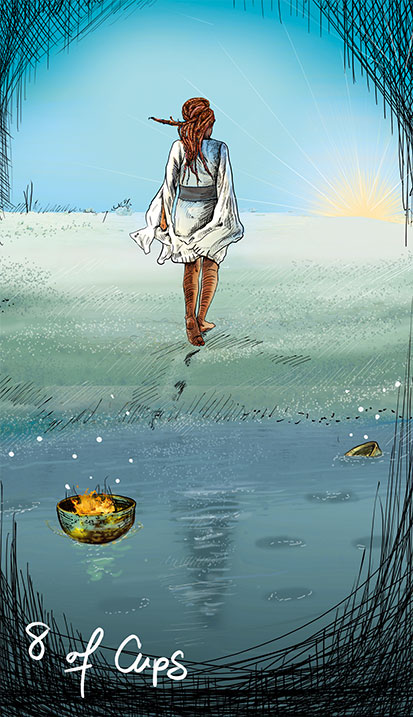
In the Rider Waite Eight of Cups, we are confronted with the moment of transition. We see a cloaked figure taking off to a barren land leaving behind eight golden cups. He is tired of what those cups, that he has spent so much time collecting, represent and is now setting out seeking a higher purpose. It may come from boredom and restlessness or from sheer necessity.
In a general context, the Eight of Cups represents abandonment. It can signify walking away from people or situations in your life or abandoning your plans. It can indicate disappointment, escapism and turning your back on or leaving bad situation.
For seven years, Gorr’s character, Elle McFeast broke new ground, taking over as Live and Sweaty host before expanding her repertoire with different McFeast-badged shows. High-profile federal politicians such as Paul Keating, Peter Costello and Kim Beazley played along, recording scenes unimaginable in today’s no-risk political culture. Then, in a blink, thanks to a controversial interview with ‘Chopper Reid’ McFeast became toxic. Having the character, the work, the fame and her future plans ripped away so abruptly, threw Gorr into a crisis of identity.
Van Diemen’s Land was the colonial name of the island of Tasmania used by the British during the European exploration of Australia in the 19th century. A British settlement was established in Van Diemen’s Land in 1803 before it became a separate colony in 1825. Its penal colonies became notorious destinations for the transportation of convicts due to the harsh environment, isolation and reputation for being inescapable. Macquarie Harbour and Port Arthur are among the most well-known penal settlements on the island.
“Sometimes you don’t realize your own strength until you come face to face with your greatest weakness.” – Susan Gale
Strength Card Light Seers Tarot
Between 1788 and 1868 more than 162,000 convicts were transported to Australia. Transportation as a form of criminal punishment emerged in the British legal system from the early 17th century as an alternative to execution.
Many of the crimes for which they were transported are considered minor offenses by today’s standards. The most common crime by far was stealing—food, clothing, money, household items—mostly items worth no more than £5.
One can only imagine how my great great grandmother, Mary Ann Maule, had been living prior to her sentencing after a series of petty thefts. Clearly Mary was no angel but conditions in Liverpool were particularly harsh. Houses were severely overcrowded and the impact of the Great Famine, known as the Irish Famine was profound.
Friedrich Engels was shocked when he visited Liverpool in the 1840s. “Liverpool, with all its commerce, wealth, and grandeur yet treats its workers with the same barbarity. A full fifth of the population, more than 45,000 human beings, live in narrow, dark, damp, badly ventilated cellar dwellings, of which there are 7,862 in the city.
“Strength does not come from winning. Your struggles develop your strengths. When you go through hardships and decide not to surrender, that is strength.”– Arnold Schwarzenegger
Having survived the long, perilous journey on board the convict ship, there can be no doubt that life would have been no easier when she arrived in the colony. However, the scarcity of women opened up opportunities for convict women as servants and wives. Many, including Mary Ann, successfully merged into colonial society, creating new families, and through good conduct and hard work forged new lives. Convict women, like my great great grandmother, demonstrated a diversity of character, aspirations and behaviour, which contradicted their stereotype as ‘damned whores’.
Her legacy of strength and fortitude has been far reaching.
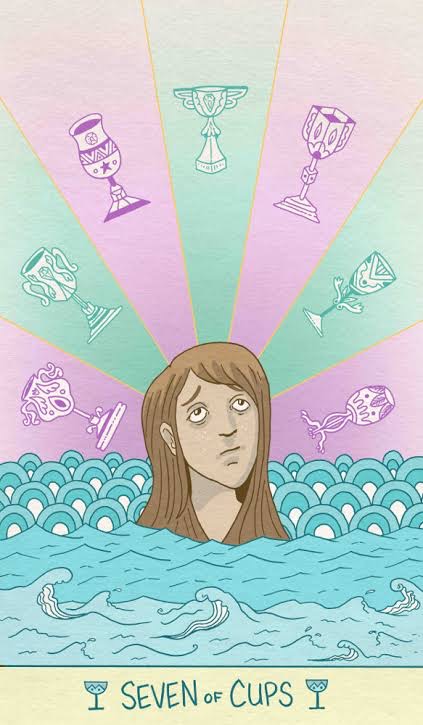
Passion is the fuel that powers the engine of our desires and our ambitions. The challenge for most of us is to learn to channel our ambitions wisely, or they can ignite and blow things up. One of the dilemmas when are confronted with the Seven of Cups is that we can feel like we are drowning, feel utterly overwhelmed.
Kabbalists are said to call the Seven of Cups tarot the Lord of Illusory Success! Unfortunately it can all be like that mirage you see in the desert! Like the Wizard of Oz it can all be an illusion, all done with smoke and mirrors.
Happily the Seven of Cups does allows us to explore our wildest, most exotic fantasies without having to worry about the real world consequences. Writing our discoveries into your journal or expressing them artistically will be very instructive.
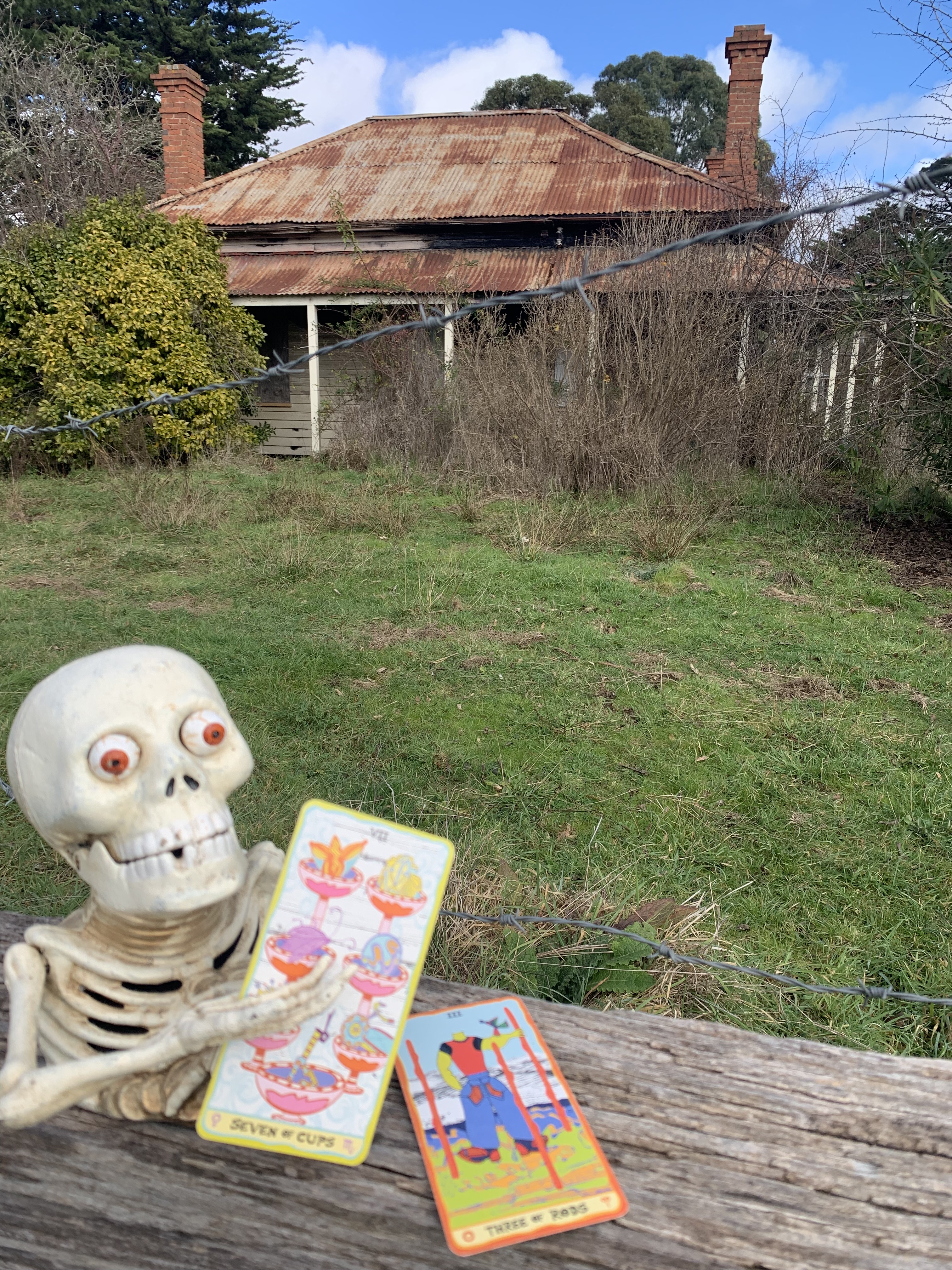
Alternatively, if we are lucky enough to have one, we can send out an SOS and seek advice from a Zen Master. As luck has it, Skellie Stan bridges the gap for me and is willing to act as a conduit and pass on advice from the dead and abandoned. It was his idea to go to a grave of a creative man that we have often noticed in a nearby cemetery, and to stop at one of the farm houses that has long been abandoned. He seemed to think that they would be responsive.
Jack, who resides in this amazingly kept grave was quite emphatic, telling Stan to tell me that I must select cups that support the creative work I am doing, while the old house suggested that I chill it a bit, relax and enjoy life. The advice feels compatible.
CarlJung separates parts of our personality out into ‘that which we are conscious of’ and elements ‘that which we are unconscious of’. Our conscious mind is where the ‘ego’ sits and is made up of the parts of our personality and identity that we are aware of.
The trouble with personas, according to Jung, is that it can lead to aspects of one’s personality (both good and bad) being unexplored, underdeveloped, and suppressed. Through a desire to please others, we focus on our qualities which we perceive to be acceptable by others and hide the parts of ourselves which we believe to be negative.
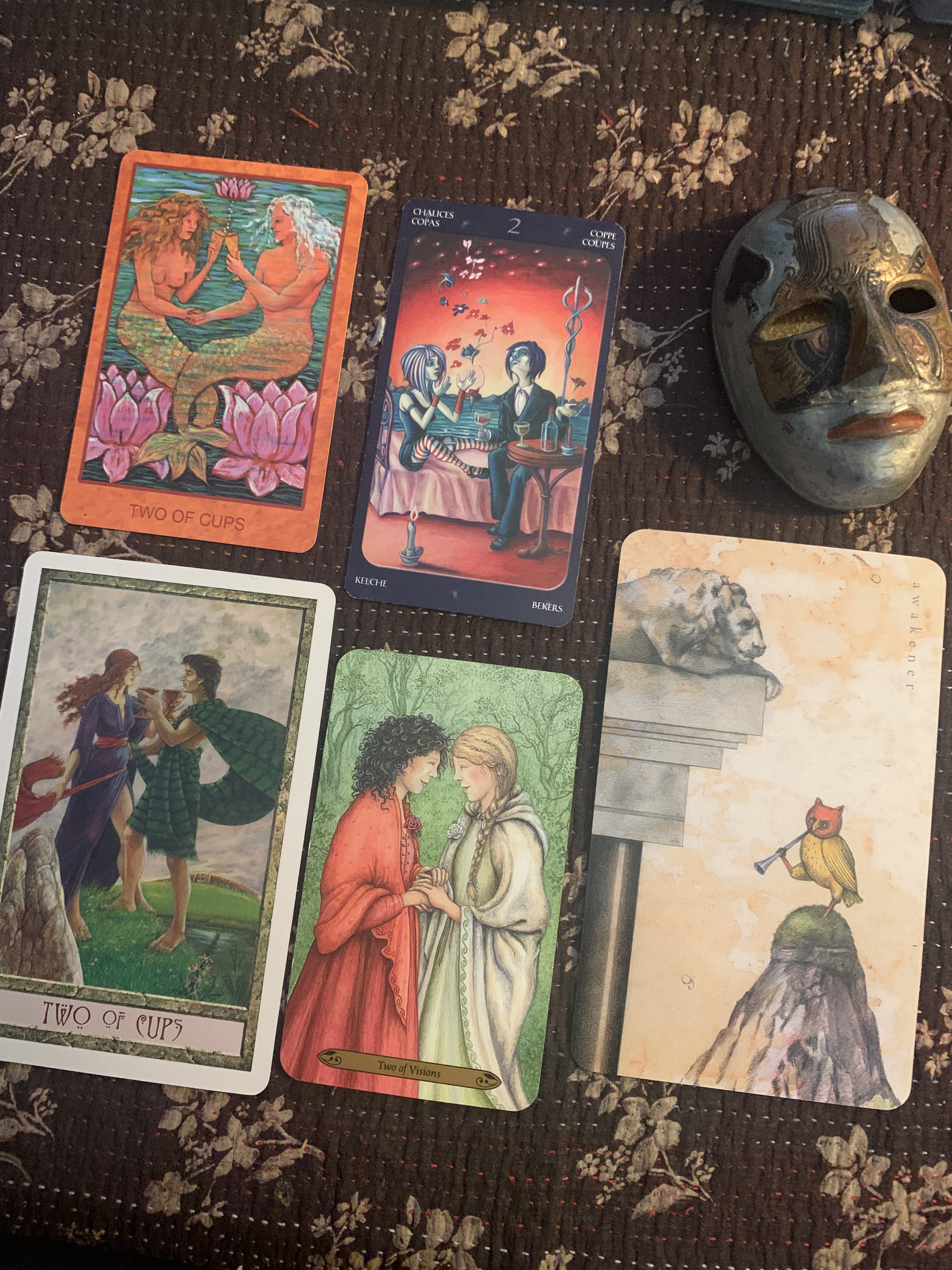
The Two of Cups generally shows a young man and woman, exchanging cups and pledging their love for one another but the symbolism of this card encompasses so much more than just romantic love. What we see here might also indicate the beginning of a lifelong friendship, a “meeting of the minds” – or any situation in which human energies enrich and transform one another.
Another approach is to take the opportunity to court, to romance a part of yourself that has been underdeveloped. To identify such an aspect you might lay out Two of Cups cards from a number of deck (see above). Then place a card from the Archeo, Personal Archetype Cards by Nick Bantock or from the Carolyn Myss Archetype Cards. Spend some time in your journal exploring the benefits of connecting more fully with this archetype.
Decisions Decisions!
Flip through an archetype deck and decide which archetypes need a bit of love, need to be courted and activated. Lay down the cards and perhaps make use of a Show Me style deck to pose a question to begin some work with these archetypes. See example below. Dialogue with the archetype and work out how you can use the energy of, in this case, the Ace of Rods.
To the extent you’re aware of the archetypes operating within you is an indicator of your level of consciousness.
“The Tower – whatever it represents in your reading – comes crashing to the ground. All that you held to be true is suddenly…not true. The world looks different, and it can feel like a disaster. This card’s usual image of lightening destroying a tower is incredibly scary – destruction is all that we can see. The ground is unsteady beneath our feet. We don’t know what to hold on to”. Little Red Tarot
Back in the 1950’s, when dinosaurs may have still roamed the world, on a humid summer afternoon, I could not have been aware that events would mean that my world would look very different for awhile. I can only have been two or three at the time, so all I have are the stories that were subsequently told.
My father loved his sport and he was a keen cricketer in the summer and a football umpire in the winter. Clearly my brothers went to the cricket match with him on this fateful day. My eldest brother was in the car watching from a distance while my other brother was on the side lines. When the storm came in and the thunder cracked the team and my brother sheltered under a tree.
The lightning that struck the tree must have looked spectacular. My elder brother was certainly traumatized by having witnessed this.
“It looks like somebody threw a cannonball through it.”
The whole team, including my father and brother felt the full force of the lightening as it struck the tree they were sheltering under. I can only imagine their shock when it hit like a cannonball. Have you ever got a static electricity shock? When lightning hits the same thing happens, but on a much bigger scale. The majority of injuries and deaths are caused by a ground current, where lightning hits a nearby object and then travels through the ground in all directions.
Amazingly they all survived but at the time, the local doctor in our small country town struggled to know how to treat them. My brother was sent, repeatedly, to Melbourne for skin grafts, the scars of which remain to this day.
Your Turn
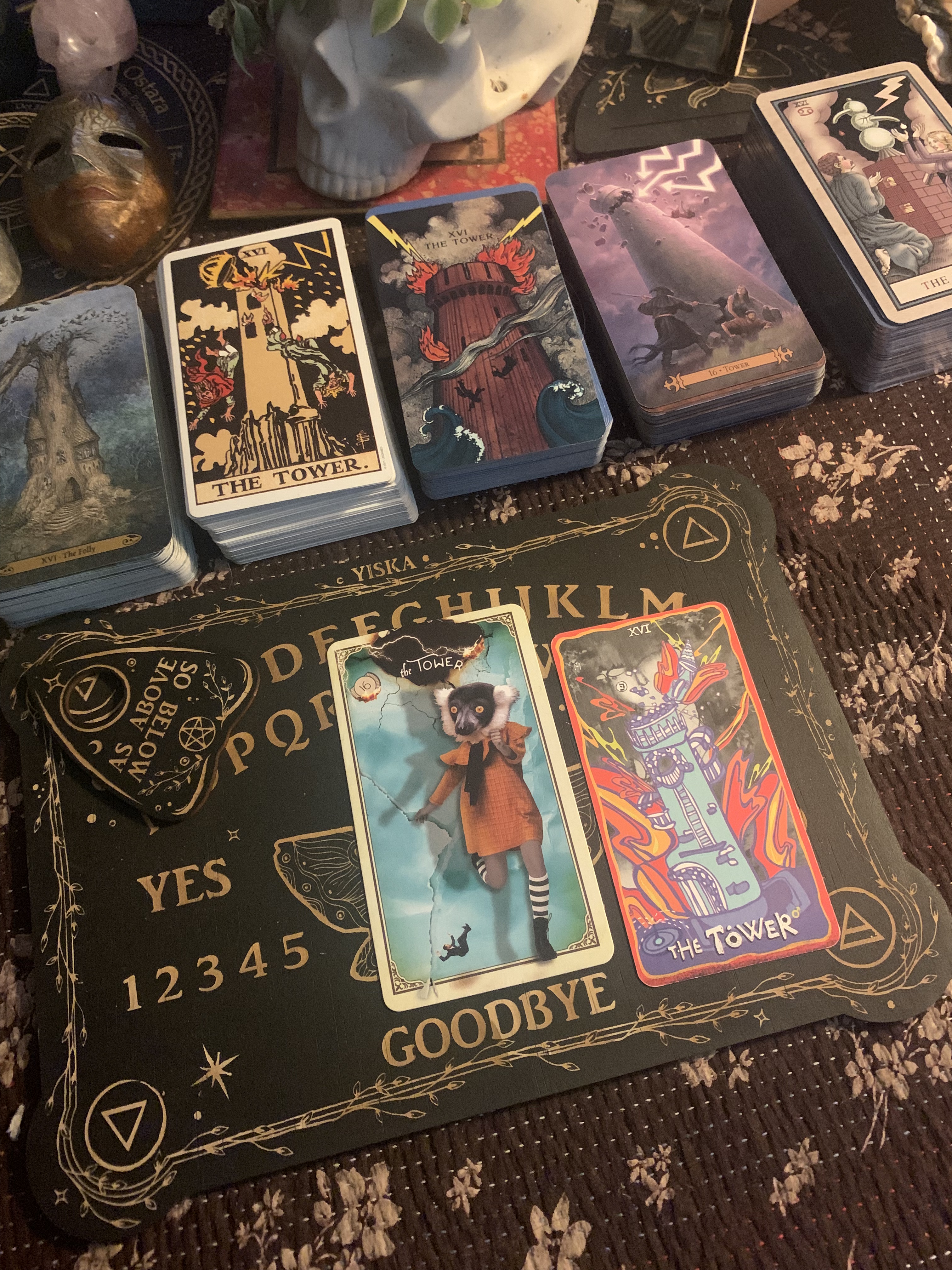
Lay out a collection of Tower cards and make a spontaneous list of Tower moments that come to mind. Write in the first or third person about this event.
“The Tower has a simple meaning: The crumbling of the status quo. This card’s usual image of lightening destroying a tower is incredibly scary – destruction is all that we can see. The ground is unsteady beneath our feet. We don’t know what to hold on to”. Little Red Tarot
Having your home destroyed by fire or flood, quitting your job, getting fired, finding yourself living rough, being ghosted by someone you love, losing a friend, having a loved one die are all examples of Tower moments. Lets state the obvious. The shock from events like this feels incredibly painful and sadly, there are rarely any quick fixes. But, eventually, despite our despair, most of us pick ourselves up and slowly rebuild.
Without sounding glib, or suggesting that doing a Tarot spread will fix things, it must be said that working with cards may help adjust one’s perspective and help someone find a way forward. Assuming you have come up for air this is an example of a spread with cards that might help you find some clarity. The Show Me cards are great because, at a time when you are not sure what you want to know, they help you ask whoever is listening, to just shed some light on possible options.
Rather than provide a ‘reading’ of the cards that appeared from the Forest of Enchantment Tarot, I’ll let you consider which responses are in any way helpful.
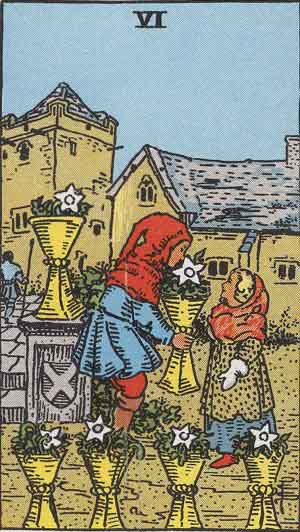
The Six of Cups symbolize the joy of nostalgia, the comfort of home and childhood innocence. In the card itself, there are six cups filled with white flowers. Two children are depicted in the foreground, and one is passing a cup to another. This handing of the flowers from the boy to the girl shows the passing of traditions and happy reunions. The children seem to be in a castle of sorts, that we can imagine give them a sense of security and comfort. from Labyrinthos
The traditional title, The Past, reminds us of our original nature, when we were young and enthusiastic, when anything was possible and the future was an open book. We are to remember that this same freshness, those new possibilities, are always available to us, even now.
If the Six of Cups has presented itself to you it may be a good time to reminisce about childhood and the books that made a deep impression on you and have, in some small way, influenced choices you have made. While you cannot bring the past back you can revisit and experience the joy of escaping into a fantasy world.
Children’s Literature is extremely vital as it provides the child with the chance of responding to literature and developing personal opinions. Moreover, it encourages deeper thoughts and emotional intelligence and imagination; it cultivates growth and development of personality and social skills. Those, like Ruth Park, who write for children, generally provide an escape from reality for children, taking them into exciting fantasy worlds that they might never know otherwise. The impact of their work is almost impossible to quantify.
Rosina Ruth Lucia Park was born in Auckland, on August 24, 1917 but spent most of her life in Australia. Her Scottish father had migrated to New Zealand to work as a labourer on road- and bridge-building projects. Park spent her early years as the solitary child in camps for road workers. Romping in forests she developed a fertile imagination, also inspired by her father’s tales of Scottish heroes.
Rosina Ruth Lucia Park AM was a New Zealand–born Australian author. She wrote a number of books for children but possibly her most popular children’s book was the much loved Muddleheaded Wombat.
In a piece that she wrote to tell children about her life she wrote that “many years ago I was born in that green, snow capped archipelago called New Zealand, and I’m very glad I was. Probably I am a writer because I had a singular childhood. My first seven years I spent all alone in the forest, like a possum or a bear cub. It was rain forest, pathless, dense; its light was a dim green twilight. How did I get there?
My father was a bridge builder and road maker; he drove some of the first roads through the forested Crown lands of northern New Zealand. My mother and I travelled with him, living in tents beside mountain streams lively with trout and eels. My father’s head was crammed with the savage hero tales of his ancestral land, Scotland. How lucky I was that he had the gift of storytelling! You must imagine lamplight, owls hoo-hooing, the tent fly cracking with frost, and myself, this bear cub child, listening to the stories I would play out by myself in the bush, next day. I developed an imagination both rich and rowdy. But there was one thing I had not imagined. When I went to school at last, I was totally astounded, almost frightened, to see children playing together. I hadn’t known they did that!
Although I loved school, I wasn’t at all interested in children’s games. However, I learned how. to pretend, and became on the surface just another kid, though inside I knew I wasn’t. This didn’t make me happy. I really believed I was a changeling. (We didn’t know the word ‘alien’ then, otherwise I would have thought I had been dropped by a Rigelian spaceship.) I longed to be like everyone else, but my solitary early life had made me different somehow. My friends were almost all Maori children, little forest creatures like myself.
By the time I was eight I was writing. I entered all kinds of verse and story competitions, and when I was eleven I won one of these. My story was published. This went straight to my head. I saw my life’s work laid out before me, and have never stopped writing since. I think, even at the age of eleven, I felt comfortable writing, more the real person I knew I was.” From Becoming a Writer by Ruth Park
May Gibb
Within the Tales of Snugglepot and Cuddlepie May revealed herself as a committed conservationist with the opening inscription ‘Humans Please be kind to all bush creatures and don’t pull flowers up by the roots‘.
Visit the official May Gibb site for books and merchandise. (This is NOT an affiliate site)
May Gibbs (1877 – 1969) is one of Australia’s most treasured illustrators, artists and children’s authors. Her bush fantasy world has captured the imaginations of Australians for over a century, creating a uniquely Australian folklore that holds a special place in the hearts of a nation. May was to say in later life ‘I’ve always had the greatest pleasure in thinking of all those little children who enjoyed my books. Everything became alive for me, it was just a fairy tale all the time.’ Born Cecilia May Gibbs in England on 17 January 1877, she was the only daughter of artist, cartoonist and public servant Herbert William Gibbs and Cecilia Rogers.
May emigrated to Australia with her family in 1881 aboard the Hesperus at four years of age. First trying their hand at farming in South Australia, followed by two years at Harvey Cattle Station in Western Australia, the Gibbs family eventually gave up on the farming life and settled at ‘The Dunes’ in Perth.
Over this time the young May spent many impressionable years observing the beauty of the Australian bush. In later years May was to say ‘It’s hard to tell, hard to say, I don’t know if the bush babies found me or I found the little creatures’. Raised in a creative household, May demonstrated artistic ability from an early age – ‘I could draw before I could walk,’ May was to recall. May excelled at botanical drawings and in 1892 at just fifteen years of age May won her first Art prize at the Perth Wild Flower Show, the first of many throughout the 1890s.
For the full online autobiography and to learn about the diversity of Gibb’s work, visit the official May Gibb website
“The Six of Cups can often be about connecting backwards, with family, grandparents, or perhaps ancestors. Think about the place from which you came, and your relationship to it now. In what ways to you carry forwards your own root?” Little Red Tarot
The Six of Cups represents innocence, nostalgia, and positive thinking. The card has an overall feel of childhood and nostalgia.
It is no accident that in movies like Titanic we see the dying Rose being reunited with all the people who were on board that fated ship. This is very Six of Cups nostalgia that reduced most of the audience to tears
Faced with death on the battle field of the Great War its not hard to believe that Bubs Corbetts thoughts would have turned to the country, family and the lifestyle he had left behind.
In the face of so much death and horror one can only hope that Bubs gained some comfort remembering the love and the bonds of relationships that he left behind.
It would be reassuring to think that, like Rose or Maximus Decimus Meridius (The Gladiator), he found his way back ‘home’ to walk in the door and be greeted by his loved ones.
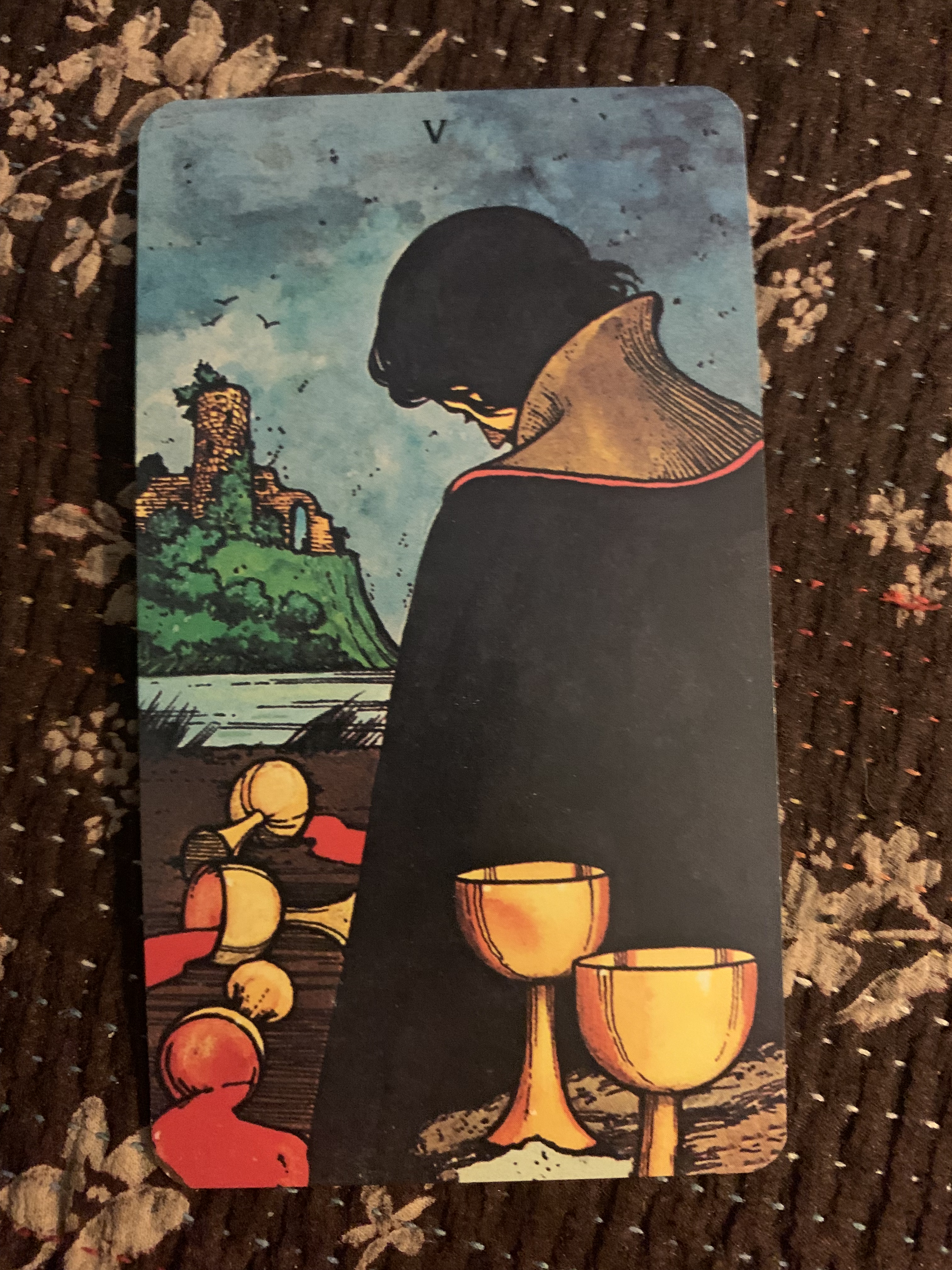
Key word associated with the 5 of Cups include – Sadness, loss, grief, despair, abandonment, guilt, remorse, regret, trauma, bereavement, mourning, heartbreak, unwelcome change, emotional instability, focusing on loss, focusing on negative emotions, isolation, loneliness, emotional baggage, divorce, separation, anger, disappointment
“The 5 of Cups card can remind us of an old wound. If there’s anything you have ‘stuffed down’ in the past, a grief, guilt or grudge that you carry, now is a good time to face that. Don’t be afraid of it – make some space in your life so that you can gently acknowledge what happened. This is about healing, and that begins with being truly honest about how you feel”. Source: Little Red Tarot
Sometimes when we work with Tarot and Oracle decks cards appear that mirror feelings we may have been trying to submerge. When the 5 of Cups shows up we can either slip it back into the pack or face and work with the kind of feelings that are frequently associated with it.
Beth from Little Red Tarot writes that “the Five of Cups shows us a moment of pure sadness. There’s very little here, but a figure, standing sadly beside overturned cups. What happened? It doesn’t really matter. Whatever those cups held is now gone, and this person is left to deal with it.
What is impressive about Beth’s post is that she gives permission to grieve when she says things like “let yourself be sad. If you’re putting on a brave face or being strong for someone else (or for yourself), now is the time to drop the act. Really give yourself the space to feel what you feel. It may be simple grief. It may be a complex mix of things. Go with it.”
By contrast, Elliot says that “when the Five of Cups comes up in a reading, its message is to “Snap out of it!” Admittedly he does offer a strategy for shifting focus from negative thoughts. He suggests that you “remember the details of your favorite place” saying that “this may be a park you visit, or a particularly beautiful place you traveled to”. He encourages you to think about “your happiest memory of a place to close your eyes and remember each of the details of the place”.
Of course, doing this may prove challenging if you are in the grips of a major bereavement. Being told to snap out of it may distract you momentarily and allow you to discharge some anger as you slap the person dispensing such advice. In fairness to Elliot he is writing about more mundane matters of the heart and his advice is very sound in such situations.
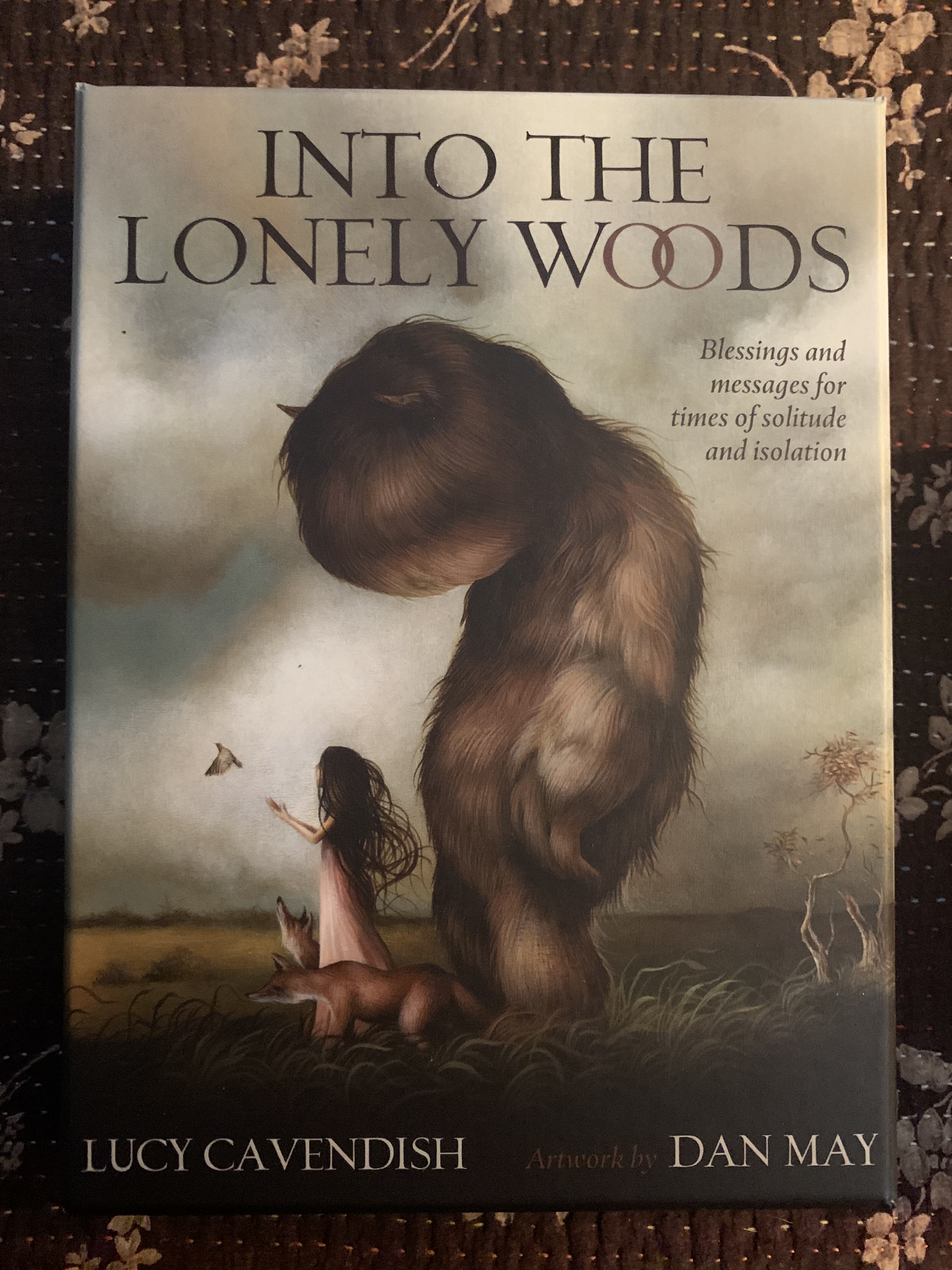
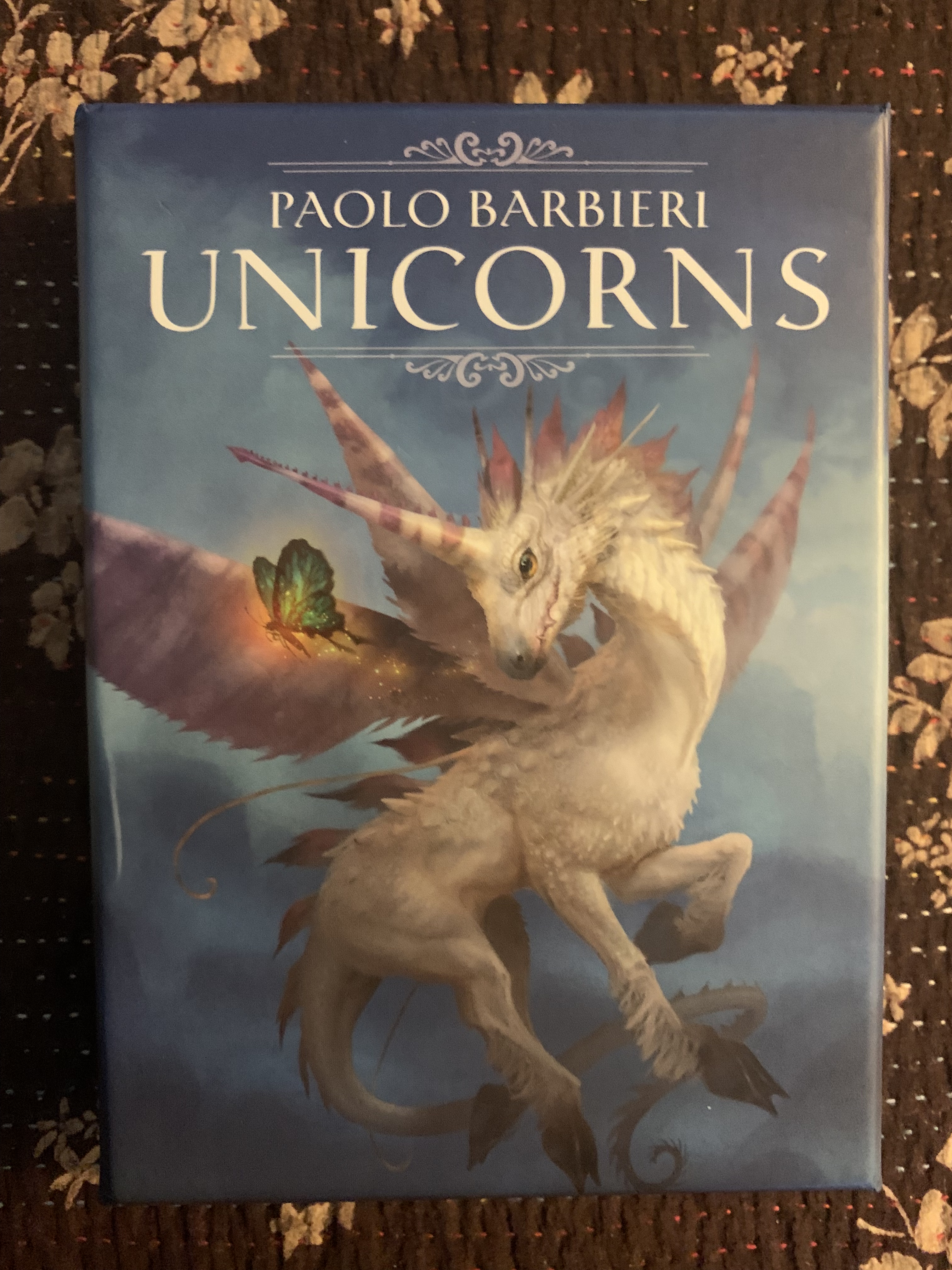
Likewise, working with gentle Tarot and Oracle decks is another soft option if you are caught in a whirlpool of disappointment and heartbreak. Wicked Moonlight has a great video where she talks about her top gentle decks.
Personally I have a couple of readily available mass market decks that I turn to when I am in a 5 of Cups state, just “want to suck worms” and have no capacity to talk to another person about whatever is bothering me. Each of these decks have wonderful guided books and the Barbieri guidebook includes highly creative guided imagery exercises which are perfect for when you are lying in a foetal position under the doona cover.
The Six of Pentacles represents compassion, generosity, and cultivating good karma. This card reminds you that your true quality as a person is not measured by how much you impress the powerful and influential people of society. Instead, it is measured by how you treat the outcasts, the penniless, and the “least of these.” When you show kindness to those who you would probably gain “nothing” from, you may find that you walk away with a gift far greater.
Northern Animal Tarot
Caroline Chisholm was born in Northampton, 30 May 1808. This was a time of turmoil. On the continent, Napoleon was wreaking havoc, and the wars undertaken to defeat him were sapping Great Britain of her resources. The Industrial Revolution was in full swing, and by the late 18th century there had emerged a massive underclass of “deserving” poor, many without means of subsistence. To deal with the poverty, a support system loosely based on the Christian principle of charity was espoused.
Born in 1808 into the reasonably well-to do family of William Jones, a yeoman farmer in Northampton, Caroline Chisholm received an education that reflected the times. As a young girl, she visited the sick of the neighboring village, providing them with help and care, and was, in the words of one biographer, educated to “look on philanthropic labor as a part of her everyday life.”
At seven, she displayed a passionate interest in immigration. Having heard wondrous tales of far-off lands in what has been characterized as an enlightened household, she invented an immigration game. Using a wash basin as the sea, she “made boats of broad-beans; expended all [her] money in touchwood dolls, removed families, located them in the bed-quilt and sent the boats, filled with wheat, back to the friends.” This early interest in immigration would later provide a focus for her rising philanthropic passion.
When she arrived in Australia in 1838 she was horrified by the desperate situation of single emigrant women who were exploited when they first arrived. Often when emigrants arrived they were taken advantage of by people who would rob them or take their money on pretense of getting them accommodation or employment. The situation was particularly bad during the depression of the 1840s. Her advocacy for homeless girls and poor families during Australia’s formative years caused her contemporaries to see her as ‘the indispensable woman of the time’.
Fast forward to 2022 and one cannot help but wonder what a woman like Carolyn Chisholm, whose name is used by so many organizations working to address homelessness, would make of the situation facing so many people. In Victoria alone, on any given night, there are approximately 1,100 people sleeping rough and older women are the fastest growing group to experience homelessness in Australia.
What would Caroline Chisholm do?
Suggestions Caroline Chisholm might offer about making a difference to homelessness in Australia in 2022
Imagine you are a journalist and you have the opportunity to interview Carolyn Chisholm. Research and find out more about her, the opposition she faced and the contribution she made. Upon meeting with her, ask five open ended questions about actions she would take to alleviate homelessness. See if what she says to you resonates with the suggestions being proposed here.














 Wild Mother Calling